Sunday, January 12, 2014

SPOTLIGHT: The Binding / Sam Dogra

Today, I'm happy to spotlight The Binding, Book 1 of the "Chronicles of Azaria" series by Sam Dogra.


Description:

What do you do when you can't trust your heart?

All seventeen year-old Eliza Bryant wants is to avoid a Binding— the ancient spell that forces couples into a lifelong bond. It cursed her sister, and for the last two years it’s tried to claim her, too. Her monthly hiding ritual worked brilliantly, until the night she ran into Ryan, a mysterious bounty-hunter. Now Bound to him, Eliza must spend every moment at his side, else she’ll transform into an Unbound; a lifeless husk without mind or soul.


Unfortunately, Ryan’s not looking to settle, and Eliza is dragged into his crazy life on the run. Still, she’s not going to take this lying down. Between grappling with the false feelings conjured by the spell and fleeing an unseen enemy, she plans to find a way to break her Binding; a feat nobody’s achieved in two thousand years. The key to her freedom lies closer than she thinks, and it’s deeply connected to Ryan’s past.


REVIEWS

What an interesting concept, just seeing someone by chance and then provided the timing is right, you find yourself bound to them forever. Sounds a bit like a "love at first sight" only the two people have no choice in the matter due to a "Binding Curse." Eliza hoping to outwit the curse escaped into the forest only to be thwarted by a wild bear so was it fate or circumstance? I liked Eliza though I sometimes felt that honesty would have been the best policy. I did understand why she was reluctant to own up to the binding as she barely knew Ryan.
Ryan was actually a good guy and he seemed genuine though he was on the run himself and had secrets of his own that he was keeping from her. Desperate to hide the truth from her family, she flees her home with Ryan making up a sordid past for herself. A love triangle of sorts ensues when her childhood friend Adam finds out about the binding as he yearns for something more and sets out to find her.
When all the secrets have been revealed, will Eliza be able to distinguish how she really feels. If there is a chance that the curse can be reversed, who would Eliza pick if she was free to choose? Her childhood friend Adam that she shares a history with or Ryan who claims to love her now despite his binding to another. I can't wait to read the next book to find out more about this triangle and will true love eventually prevail? – Nereid, Amazon

4.5 Stars. This exciting tale for New Adult/Older YA crosses genres making it difficult to categorise in any one area. Set in another world it has elements of sci-fi, fantasy and a just touch of steampunk. The characters are magnetic and quickly draw you into this exciting world where curses and magic become real. This passionate tale becomes unstoppable leaving you devastated that the second instalment is yet to be published - not a cliff-hanger, just totally addictive writing. – Tracie, Goodreads

Awesome! Can't wait for the next one!!! – Molly Bonville, Goodreads

The Binding, by Sam Dogra, is an excellent read, with superb settings and characterisation. I really cared what happened to the main protagonist and the first person point of view, really helped me to become immersed in the story. Only one minor criticism. The, use of the word "to" instead of "at". For example: "Ryan looked to the moon", or "I looked to my lap". This jarred me a little, but apart from this nitpick, this is an almost perfect story and one readers of all ages will enjoy. Highly recommended. –Kate Jack, Amazon

ANIMATIONS


AUTHOR BIO
Sam Dogra is a junior doctor working in the UK, and is currently training to become a General Practitioner. Between reviewing drug charts and X-rays, taking blood, saving lives and getting grilled by consultants, she also writes fantasy fiction and is a fantasy artist. She has co-written 'Fated: A Timeless Series Companion Novel' with author Lisa Wiedmeier, and has also published her first novel The Binding, and its sequel, The Parting, with a third book in progress.

She's widely traveled, and has enjoyed her visits to France, Germany, Norway, Greece, Egypt, Israel, Rhodes, Turkey, Cyprus, Lesvos, India, Dubai, Australia, Canada and Idaho, Washington, New York, Seattle and Alaska, USA. Her other main interest is fantasy art.

In what little spare time she has, Sam also enjoys reading, baking, shopping, watching movies and anime, astrology, video games, collecting cuddly toy animals, and photography.

LINKS


PURCHASE LINKS for BINDING


Wednesday, January 8, 2014

AUTHOR INTERVIEW: Geoff Livingston

An interview with Geoff Livingston, author of Exodus.


Hi! Welcome to Zigzag Timeline. Can you tell us about your background as an author?


I actually started as a business author. Publishers were more interested in my success as a social media marketer and not my first attempts at writing novels. However, after my third business book, I turned back to fiction. I learned enough about the book publishing process to feel comfortable going the independent route.


What got you into writing?

My folks are both journalists, so you could say it runs in the family. As a child, I grew up reading science fiction novels from Asimov, Brook, Clarke, Heinlein and Tolkein. It became a dream of mine to write science fiction. Then in college I became a Literature major, and the rest is history!

What was the first idea you had for your book, and how did the story grow from there?

While Exodus has a serious bend towards examining religious fundamentalism, it was actually grounded in a collegiate study of Marxism in the early 90s. I appreciated Marx’s utopian dream, but realized it was unattainable. What would disrupt it? Personal greed for wealth and power as manifested by religion, technology, and/or money.

The book kind of took off from there. I decided to riff off of the Exodus concept in the bible and some Greek characters, and the novel kind of mapped itself.

Among your characters, who's your favorite? Could you please describe him/her?

I like Mordecai, actually. He’s inevitably human. He gets suckered, is cranky, and tries to do the right thing as it appears in the moment. Of course, sometimes he is very, very wrong, like his initial support of Pravus that helped create the Empire. Plus he is bent on doing things the old way, and knows his way around a linrary. That’s why I like him so much.

What's your favorite scene from your novel? Could you please describe it?

There is a scene when the villagers must cross the Ohio river. You know it’s dangerous, and all hell breaks loose. I think that’s the low point for the village and its heroes.

What's your favorite part of writing? Plotting? Describing scenes? Dialogue?

I enjoy dialogue. Describing scenes is a bit dangerous because you can easily slip into telling and not showing. Through dialogue we can show events as they unfold in a more natural fashion. When you communicate through conversation, you reveal information as it is often transferred between people.

In real life we learn and grow from interacting with each other, and then reading and writing. Even when you are out and about as a child, experiencing the real world, your parents and friends tell you about the things you see, helping to shape your perspective.

How long does it take you to write a book? Do you have a writing process, or do you wing it?

It takes four to six months usually. I try to write every day, roughly 500 to 1000 words. Sometimes my professional work demands that I write something else, but nevertheless I write. And this lets me tap into the creative process naturally. I try to write in the morning when I am fresh, but can pretty much do it at anytime.

What is it about the genre you chose that appeals to you?

I like how science fiction allows us to dialogue about real possible scenarios with technology and society. We can envision what’s coming, and even weigh how we want the world to adapt technology, ideas or not at all.

I think dystopian fiction gives us a strong look at the human dark side, and we need that. How correct was William Gibson about Neuromancer? If you ask Eric Snowden, Gibson was spot on.

Are there any books or writers that have had particular influence on you?

J.R.R. Tolkien was a huge influence, as was Asimov. Many of the authors mentioned were influences, and today, I follow modern science fiction writers David Brin, Charles Stross and John Scalzi online.

But perhaps my greatest influence was Thomas Hardy. See, he worked as a normal person until about 40 years of age. Then he became one of the most successful novelists of the 19th century. I needed to take the path I did to become successful, but because of Hardy, even though I am 41, I know there’s hope that I, too, can become a great novelist.

Did you ever surprise yourself when you were writing your book? Characters who took on lives of their own? Plot elements that took unexpected turns?

Yeah, that’s definitely part of the journey of writing a book. I am experiencing that right now with the second book of the The Fundamentalists and Marcus. He was really supposed to be the nice guy, but he’s changing quite a bit and becoming more, shall we say dark? I don’t want to say more because it would reveal the arc, but it’s surprising to me.

In the case of Exdous, I think Elliot’s final scene with Pravus revealed a much more dynamic tension than I anticipated. That tension is an undertone that serves as a backdrop throughout the second book. Yet, that scene didn’t exist until March of this year, even though I had rewritten the book several times over the course of the past twenty years.

Thanks for stopping by!

Links:
Twitter: @geoffliving


Saturday, January 4, 2014

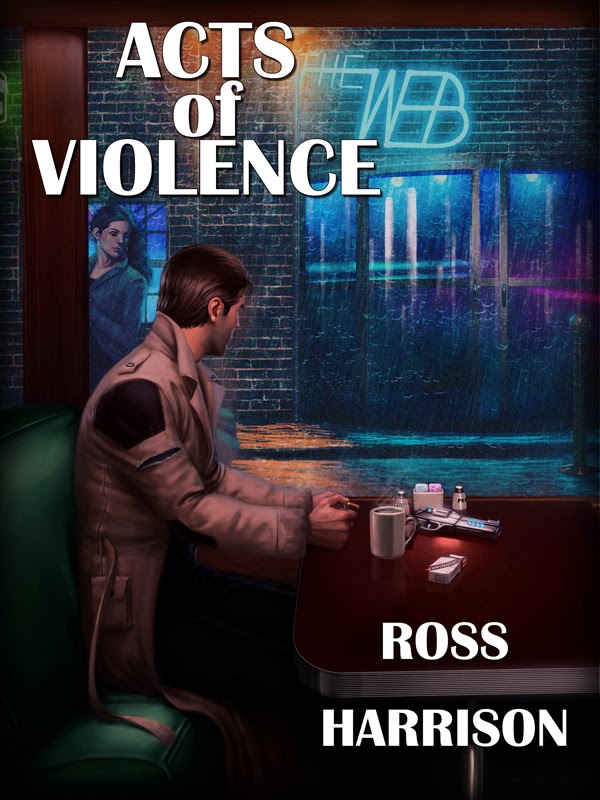
COVER REVEAL: Acts of Violence / Ross Harrison

Today, I have the pleasure of revealing the cover of author Ross Harrison's latest work, Acts of Violence. Looks awesome!


My name's Jack Mason. I made a mistake. Took home the wrong girl. Now she’s dead. Cut up. And they’re telling me I did it.
It's the same cop that tried to take me down ten years ago when I killed my girlfriend. Now he’s coming at me hard. And he’s not the only one. Cole Webster, the city’s crime lord, thinks I stole something from him. Broke me out of the precinct just to ask me about it. Then I killed his son. Now he really wants me.

Add to this equation a government agent, and I’m a real popular guy right now. Pretty much everyone I meet wants me dead, lawfully or otherwise. There’s nowhere to run. Nowhere to hide. I’ve got till morning to uncover Webster’s trafficking operation and take the heat off me. And all I’ve got to go on is a pissed off homeless girl with a thirst for revenge.

Guess it could be worse. Can’t quite figure how.

Sunday, December 29, 2013

The most flattering feedback I've received for Artificial Absolutes...

…has got to be this: https://sites.google.com/site/eyalmozesonobjectivism/artificial_absolutes_intro. It's a philosophical essay inspired by Artificial Absolutes -- the themes of man versus machine, sentience, and emotion. While the essayist, Eyal Mozes, and I don't necessarily see eye-to-eye on all matters, I'm thrilled that my book sparked this kind of thought-provoking writing.

When I set out to write Artificial Absolutes, I initially focused on the adventure element -- the plot, the characters, and the crazy things they go through. But as I delved further into the writing, I found myself thinking about all the questions surrounding the various ideas I had women into the story -- primarily religion, artificiality, and consciousness. Which led to lots and lots more research and background reading than I anticipated going in. By the time I finished my first draft, I found myself not with the pulpy space fugitive book I'd planned, but something I hoped was a little more. Not that there's anything wrong with pulp; in fact, it's still pretty pulpy, which I'm glad for because otherwise it'd be a snoozefest. But despite all the rewrites it required as a result, I'm glad I let it go in a more philosophical direction.

Artificial Absolutes is meant to raise a few questions -- about what it means to be human and about what it means to be artificial. As for the answers… I won't pretend to have them. I don't think anyone ever will, and that's what makes the ideas so fascinating. Each character has their own views, and it's their views I present in the narrative, not necessary. Looking back, they do seem to coalesce into an overarching argument, and I think that's because the characters -- especially Jane, Devin, and Adam -- are necessarily cut of a certain cloth for the sake of the story (they all do crazy things against all reason).

I found Mozes's essay, written from an Objectivist point of view, to be thoroughly fascinating, and I highly recommend that people read it for its interesting and well-informed presentation of its point of view, much of which draws from Ayn Rand, the original Objectivist. (And no, this is not a marketing ploy on my part. I met Mozes briefly at DarkoverCon but didn't even know he bought Artificial Absolutes, let alone read and thought about it. In fact, encouraging people to read his essay is bad business for me, since it's chock full of spoilers -- a necessity, considering the themes and subjects he discusses.)

Being told one's work has inspired another -- that is by far the highest praise an author can ask for.


Tuesday, December 17, 2013

Names are hard

[reblogged from my Tumblr]

I'm about to embark on a new writing project after months and months of editing, which has got me all tingly with excitement. Much as I love my current world's, there's nothing quite like nurturing the first seeds of an idea (look at me, being all metaphorical!). This is perhaps the only part of the writing process that's pure fun -- just letting the ideas loose without having to worry about logistics, dumping it into a "brainstorm" document, and deciding to figure out the details later. Look at all this cool stuff that's going to happen! Look at this awesome world it's going to take place in! Look at all these fun characters I get to play with!

Then, the hard part comes. Untangling plot lines, connecting the dots, expanding the world... and naming things. For some writers, names of characters, places, and more come naturally.

Lucky ducks.

As I'm sure everyone knows, names are important. They're an inseparable part of who a character is, giving a reader a first impression and an aura of sorts. Some writers will choose to leave a character unnamed, but even that gives the reader a certain feeling about who the character is. For instance, female character with a long, flowing name often leaves the impression of one who is lovely and elegant -- like Aurianna or Isadora. A male character with a hard, monosyllabic name leaves the impression of one who is tough and down-to-earth -- like Jack or Mike.

I tend to overthink things, so when I name a character, I can't just chose something I think sounds nice. I wonder: What does this say about my character? What does it say about the people who named him/her? What's the first impression it would give about this person?

I'm also extraordinarily bad at coming up with things off the top of my head. So, now that I have a basic idea for my world, I get the lovely task of scouring baby name websites hunting for something that fits the images of the characters I have in my head. From past experience, I'll probably end up with something entirely different from what I set out to look for. Names, in a way, are like true love. When you find the One, you just know (two figures of speech in one blog post? I may be a poet yet).

Wednesday, December 4, 2013

Shadows and Secrets: My Outsiders Series


Thanks for inviting me to your blog, Mary. It’s an honor to be here and to talk about my writing. My new novel, In the Shadows: An Outsiders Mystery, is an unusual mystery novel because it has two mysteries. If you read many books in the genre, you’ll know that most mysteries begin with a murder (or kidnapping) Mine does not. It begins with a young woman, who is trying to find a job in Paris, France, while keeping her identity hidden. In the second chapter, a half-American/half-French man, Dave, is trying to deal with his sneaky grandmother who lied to him to get him to visit her in France. The characters are complicated, and the setting is most definitely unusual. The main setting is a fictitious hillside village riddled with caves and troglodyte cave-dwellings, known locally as troglos. What I tried to do was tie together the setting, the characters, and their situation, at least in some ways. The story is about trust, belonging, facades, and murder.

The original version of the book was one of my early books. The main female character, Maura, was the protagonist. But even back then, I knew instinctively that the male lead, Dave, was the better choice as protagonist. At the time, like many new authors, I had difficulty creating believable protagonists of the opposite sex. I decided to set that book aside while I studied and practiced the writing craft.

Several years later, once I was a more experience writer, I began work on a sequel to that book. But this time I wanted to create a more traditional mystery plot. The sequel would take off where the first one ended, or a while after. When I started writing it, I wasn’t sure what I would do with these two books. Maybe publish the second book, I thought. Then if people liked it, I could rewrite the first book and publish it as a prequel. Well, that second book was a breeze to write. It took about three months. After a quick edit with an editor friend, I sent it out to agents and publishers. It drew interest and was snapped up.

Flash forward a year. By now, I had decided to go the indie route for publishing. I’d completely rewritten the first book, making Dave the protagonist. Those years of hard work—and a couple of mentors—had taught me a lot. It probably helped that I had two editors who were male. I published In the Shadows at the end of October and it’s received 6 five-star reviews so far. Now I’m preparing the second book for publishing. That book will be titled Where Secrets Reside: An Outsiders Mystery. I made sure that I carried forward any changes from the first book and then I did a line edit. Now someone is reading that book. He’s only read three chapters so far and he says he really likes it. The sequel is slightly shorter than the first book, and it is very fast paced. It’s more complicated, too, with more than a dozen point of view characters. It has flashbacks, multiple story-lines, and more scenes inside the caves and troglos. I loved working on both books. I hope people will love reading them, too.