Wednesday, January 8, 2014

AUTHOR INTERVIEW: Geoff Livingston

An interview with Geoff Livingston, author of Exodus.


Hi! Welcome to Zigzag Timeline. Can you tell us about your background as an author?


I actually started as a business author. Publishers were more interested in my success as a social media marketer and not my first attempts at writing novels. However, after my third business book, I turned back to fiction. I learned enough about the book publishing process to feel comfortable going the independent route.


What got you into writing?

My folks are both journalists, so you could say it runs in the family. As a child, I grew up reading science fiction novels from Asimov, Brook, Clarke, Heinlein and Tolkein. It became a dream of mine to write science fiction. Then in college I became a Literature major, and the rest is history!

What was the first idea you had for your book, and how did the story grow from there?

While Exodus has a serious bend towards examining religious fundamentalism, it was actually grounded in a collegiate study of Marxism in the early 90s. I appreciated Marx’s utopian dream, but realized it was unattainable. What would disrupt it? Personal greed for wealth and power as manifested by religion, technology, and/or money.

The book kind of took off from there. I decided to riff off of the Exodus concept in the bible and some Greek characters, and the novel kind of mapped itself.

Among your characters, who's your favorite? Could you please describe him/her?

I like Mordecai, actually. He’s inevitably human. He gets suckered, is cranky, and tries to do the right thing as it appears in the moment. Of course, sometimes he is very, very wrong, like his initial support of Pravus that helped create the Empire. Plus he is bent on doing things the old way, and knows his way around a linrary. That’s why I like him so much.

What's your favorite scene from your novel? Could you please describe it?

There is a scene when the villagers must cross the Ohio river. You know it’s dangerous, and all hell breaks loose. I think that’s the low point for the village and its heroes.

What's your favorite part of writing? Plotting? Describing scenes? Dialogue?

I enjoy dialogue. Describing scenes is a bit dangerous because you can easily slip into telling and not showing. Through dialogue we can show events as they unfold in a more natural fashion. When you communicate through conversation, you reveal information as it is often transferred between people.

In real life we learn and grow from interacting with each other, and then reading and writing. Even when you are out and about as a child, experiencing the real world, your parents and friends tell you about the things you see, helping to shape your perspective.

How long does it take you to write a book? Do you have a writing process, or do you wing it?

It takes four to six months usually. I try to write every day, roughly 500 to 1000 words. Sometimes my professional work demands that I write something else, but nevertheless I write. And this lets me tap into the creative process naturally. I try to write in the morning when I am fresh, but can pretty much do it at anytime.

What is it about the genre you chose that appeals to you?

I like how science fiction allows us to dialogue about real possible scenarios with technology and society. We can envision what’s coming, and even weigh how we want the world to adapt technology, ideas or not at all.

I think dystopian fiction gives us a strong look at the human dark side, and we need that. How correct was William Gibson about Neuromancer? If you ask Eric Snowden, Gibson was spot on.

Are there any books or writers that have had particular influence on you?

J.R.R. Tolkien was a huge influence, as was Asimov. Many of the authors mentioned were influences, and today, I follow modern science fiction writers David Brin, Charles Stross and John Scalzi online.

But perhaps my greatest influence was Thomas Hardy. See, he worked as a normal person until about 40 years of age. Then he became one of the most successful novelists of the 19th century. I needed to take the path I did to become successful, but because of Hardy, even though I am 41, I know there’s hope that I, too, can become a great novelist.

Did you ever surprise yourself when you were writing your book? Characters who took on lives of their own? Plot elements that took unexpected turns?

Yeah, that’s definitely part of the journey of writing a book. I am experiencing that right now with the second book of the The Fundamentalists and Marcus. He was really supposed to be the nice guy, but he’s changing quite a bit and becoming more, shall we say dark? I don’t want to say more because it would reveal the arc, but it’s surprising to me.

In the case of Exdous, I think Elliot’s final scene with Pravus revealed a much more dynamic tension than I anticipated. That tension is an undertone that serves as a backdrop throughout the second book. Yet, that scene didn’t exist until March of this year, even though I had rewritten the book several times over the course of the past twenty years.

Thanks for stopping by!

Links:
Twitter: @geoffliving


Saturday, January 4, 2014

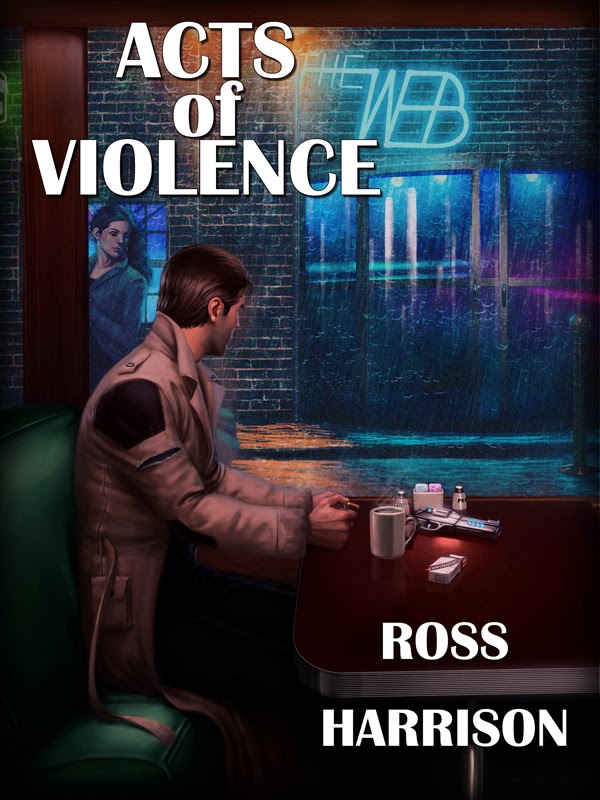
COVER REVEAL: Acts of Violence / Ross Harrison

Today, I have the pleasure of revealing the cover of author Ross Harrison's latest work, Acts of Violence. Looks awesome!


My name's Jack Mason. I made a mistake. Took home the wrong girl. Now she’s dead. Cut up. And they’re telling me I did it.
It's the same cop that tried to take me down ten years ago when I killed my girlfriend. Now he’s coming at me hard. And he’s not the only one. Cole Webster, the city’s crime lord, thinks I stole something from him. Broke me out of the precinct just to ask me about it. Then I killed his son. Now he really wants me.

Add to this equation a government agent, and I’m a real popular guy right now. Pretty much everyone I meet wants me dead, lawfully or otherwise. There’s nowhere to run. Nowhere to hide. I’ve got till morning to uncover Webster’s trafficking operation and take the heat off me. And all I’ve got to go on is a pissed off homeless girl with a thirst for revenge.

Guess it could be worse. Can’t quite figure how.

Sunday, December 29, 2013

The most flattering feedback I've received for Artificial Absolutes...

…has got to be this: https://sites.google.com/site/eyalmozesonobjectivism/artificial_absolutes_intro. It's a philosophical essay inspired by Artificial Absolutes -- the themes of man versus machine, sentience, and emotion. While the essayist, Eyal Mozes, and I don't necessarily see eye-to-eye on all matters, I'm thrilled that my book sparked this kind of thought-provoking writing.

When I set out to write Artificial Absolutes, I initially focused on the adventure element -- the plot, the characters, and the crazy things they go through. But as I delved further into the writing, I found myself thinking about all the questions surrounding the various ideas I had women into the story -- primarily religion, artificiality, and consciousness. Which led to lots and lots more research and background reading than I anticipated going in. By the time I finished my first draft, I found myself not with the pulpy space fugitive book I'd planned, but something I hoped was a little more. Not that there's anything wrong with pulp; in fact, it's still pretty pulpy, which I'm glad for because otherwise it'd be a snoozefest. But despite all the rewrites it required as a result, I'm glad I let it go in a more philosophical direction.

Artificial Absolutes is meant to raise a few questions -- about what it means to be human and about what it means to be artificial. As for the answers… I won't pretend to have them. I don't think anyone ever will, and that's what makes the ideas so fascinating. Each character has their own views, and it's their views I present in the narrative, not necessary. Looking back, they do seem to coalesce into an overarching argument, and I think that's because the characters -- especially Jane, Devin, and Adam -- are necessarily cut of a certain cloth for the sake of the story (they all do crazy things against all reason).

I found Mozes's essay, written from an Objectivist point of view, to be thoroughly fascinating, and I highly recommend that people read it for its interesting and well-informed presentation of its point of view, much of which draws from Ayn Rand, the original Objectivist. (And no, this is not a marketing ploy on my part. I met Mozes briefly at DarkoverCon but didn't even know he bought Artificial Absolutes, let alone read and thought about it. In fact, encouraging people to read his essay is bad business for me, since it's chock full of spoilers -- a necessity, considering the themes and subjects he discusses.)

Being told one's work has inspired another -- that is by far the highest praise an author can ask for.


Tuesday, December 17, 2013

Names are hard

[reblogged from my Tumblr]

I'm about to embark on a new writing project after months and months of editing, which has got me all tingly with excitement. Much as I love my current world's, there's nothing quite like nurturing the first seeds of an idea (look at me, being all metaphorical!). This is perhaps the only part of the writing process that's pure fun -- just letting the ideas loose without having to worry about logistics, dumping it into a "brainstorm" document, and deciding to figure out the details later. Look at all this cool stuff that's going to happen! Look at this awesome world it's going to take place in! Look at all these fun characters I get to play with!

Then, the hard part comes. Untangling plot lines, connecting the dots, expanding the world... and naming things. For some writers, names of characters, places, and more come naturally.

Lucky ducks.

As I'm sure everyone knows, names are important. They're an inseparable part of who a character is, giving a reader a first impression and an aura of sorts. Some writers will choose to leave a character unnamed, but even that gives the reader a certain feeling about who the character is. For instance, female character with a long, flowing name often leaves the impression of one who is lovely and elegant -- like Aurianna or Isadora. A male character with a hard, monosyllabic name leaves the impression of one who is tough and down-to-earth -- like Jack or Mike.

I tend to overthink things, so when I name a character, I can't just chose something I think sounds nice. I wonder: What does this say about my character? What does it say about the people who named him/her? What's the first impression it would give about this person?

I'm also extraordinarily bad at coming up with things off the top of my head. So, now that I have a basic idea for my world, I get the lovely task of scouring baby name websites hunting for something that fits the images of the characters I have in my head. From past experience, I'll probably end up with something entirely different from what I set out to look for. Names, in a way, are like true love. When you find the One, you just know (two figures of speech in one blog post? I may be a poet yet).

Wednesday, December 4, 2013

Shadows and Secrets: My Outsiders Series


Thanks for inviting me to your blog, Mary. It’s an honor to be here and to talk about my writing. My new novel, In the Shadows: An Outsiders Mystery, is an unusual mystery novel because it has two mysteries. If you read many books in the genre, you’ll know that most mysteries begin with a murder (or kidnapping) Mine does not. It begins with a young woman, who is trying to find a job in Paris, France, while keeping her identity hidden. In the second chapter, a half-American/half-French man, Dave, is trying to deal with his sneaky grandmother who lied to him to get him to visit her in France. The characters are complicated, and the setting is most definitely unusual. The main setting is a fictitious hillside village riddled with caves and troglodyte cave-dwellings, known locally as troglos. What I tried to do was tie together the setting, the characters, and their situation, at least in some ways. The story is about trust, belonging, facades, and murder.

The original version of the book was one of my early books. The main female character, Maura, was the protagonist. But even back then, I knew instinctively that the male lead, Dave, was the better choice as protagonist. At the time, like many new authors, I had difficulty creating believable protagonists of the opposite sex. I decided to set that book aside while I studied and practiced the writing craft.

Several years later, once I was a more experience writer, I began work on a sequel to that book. But this time I wanted to create a more traditional mystery plot. The sequel would take off where the first one ended, or a while after. When I started writing it, I wasn’t sure what I would do with these two books. Maybe publish the second book, I thought. Then if people liked it, I could rewrite the first book and publish it as a prequel. Well, that second book was a breeze to write. It took about three months. After a quick edit with an editor friend, I sent it out to agents and publishers. It drew interest and was snapped up.

Flash forward a year. By now, I had decided to go the indie route for publishing. I’d completely rewritten the first book, making Dave the protagonist. Those years of hard work—and a couple of mentors—had taught me a lot. It probably helped that I had two editors who were male. I published In the Shadows at the end of October and it’s received 6 five-star reviews so far. Now I’m preparing the second book for publishing. That book will be titled Where Secrets Reside: An Outsiders Mystery. I made sure that I carried forward any changes from the first book and then I did a line edit. Now someone is reading that book. He’s only read three chapters so far and he says he really likes it. The sequel is slightly shorter than the first book, and it is very fast paced. It’s more complicated, too, with more than a dozen point of view characters. It has flashbacks, multiple story-lines, and more scenes inside the caves and troglos. I loved working on both books. I hope people will love reading them, too.

Friday, November 29, 2013

5 Grievances Every Author Faces (and how to deal with them)

Writing books is for masochists. No, seriously. There's so much grief and misery that goes into the process of taking an idea and turning it into a novel that we authors often find ourselves wondering, "Why did I get myself into this?" At the same time, we can't make ourselves stop, so we just rant and complain and sigh, then slink back to our keyboards. And then we get into our stories, and we can't imagine doing anything else. You could say we're a bit bipolar.

Here are five things I find myself complaining about the most (with cat pictures).

5. Some people think all authors should be perfectly secure beings all the time.

No doubt, some people will read the above and think, "Well, if you don't enjoy writing, why don't you just quit?" Such comments crop up whenever someone posts about how hard it is to be a writer. Which makes sense, since ramblings of that nature tend to be self-pitying, and the source of the problem is entirely voluntary. However, we all need to vent from time to time, and what we're really looking for isn't a lecture, but a sympathetic ear.

It gets even more frustrating when the venting turns to "My book sucks! I'll never be good enough!" And someone replies with an oh-so-condescending, "Well, if you don't think your book is worthwhile, you shouldn't be writing." Again, I can see their point, but that kind of response is not helpful. We authors can be sensitive beings, and we already have little gremlins in our minds telling us to stop doing something we love because we can't handle it, or because we'll never be good enough.

The gremlins aren't entirely unreasonable, since the vast majority of writers will never be the next J.K. Rowling or F. Scott Fitzgerald, and that's what makes it worse. Part of you wants to listen, so when an external force comes in and reinforces their gloomy message, the blood starts boiling. "Hey! I'm sorry I'm not a perfect egomaniac who thinks everything I write is the next Pulitzer Prize winner!"

Zen Kitty lets the gremlins' words slide off her mind, like water off a rock.
Solution: Ignore 'em. The gremlins, both internal and external, will always exist, but that doesn't mean you have to listen. So stick your tongue out at them, thumb your nose, and remind yourself of all the reasons your book is the best thing ever. And if the rest of the world doesn't see it, well, their loss!

4. Word count envy

Before I started writing, I never thought in terms of word count. In fact, I barely even thought about book length. I noticed that the "Harry Potter" books got progressively fatter and that "Animal Farm" seemed awfully small compared to the other assigned high school readings, but otherwise, I really didn't give a damn. If anything, I might ask about how many pages a book is, or how thick it is (as indicated by space between forefinger and thumb). 

 Now, I know that the average book is 64,000 words long, and that anything over 100,000 words is frowned upon for a first novel (Artificial Absolutes was 141,000 words when I submitted it to Red Adept... oops). Why do I know this? Partially because of genre conventions and submissions guidelines (no one would read a 300,000 word chick lit book), and partially because I started hanging out with other writers online. 

 Writing is a long and tiresome process, and it's easy to procrastinate. So many writers will set word count goals for themselves to keep on track. The ultimate manifestation of this habit is NaNoWriMo (that's National Novel Writing Month to the novs out there), where people join a virtual writing community (which also holds local in-person writing sessions) and aim to write a 50,000 word novel during the month of November. Which is why right now, my Facebook newsfeed is blowing up with statuses like "OMG, wrote 5,000 words of the new book today and am exhausted!" 

Meanwhile, I haven't written anything new since June, even though I have plenty of projects on my plate. Between my time-consuming day job and editing the two books I have in the pipeline, I just don't have time. So part of me starts getting defensive when I see all these people creating so many words, even annoyed. I know I should be happy for them, and I do my best to cheer them on, but the bratty part of me wants to stomp my foot and say, "Knock it off!" At the same time, the insecure part of me wants to crawl under the covers and weep about how I can't keep up with all these awesomely productive people.


"Like I'm going to count all these words."
Solution: Repeat after me: Word count hardly matters. Yes, it's a good indicator of whether you're within your genre conventions (do NOT submit a 300,000 word novel claiming it's light-heared chick lit). And yes, it can be good for setting goals. But the number of words produced pales in comparison to the quality. George Orwell's masterpiece-turned-classroom-staple Animal Farm is only about 30,000 words more. Same goes for John Steinbeck's classic, Of Mice and Men. Meanwhile, Harry Potter and the Goblet of Fire, at about 190,000 words, is far too long for the children's section by most standards, but who cares? Whether you can pour out an epic in three months or require two years to compose a spare, quick-to-read thriller, the thing that matters in the end is the book itself. So just smile and congratulate the mass producers and remember that everyone is different, and people work at their own pace.

 3. Rules, rules, rules 

You'd think that if you were pretty good with grammar, you'd be a good writer by default, right? HAH! Not so much. There are all kinds of rules about writing fiction that, while absolutely mandatory, are strongly, strongly encouraged.

Don't use dialogue tags. Don't use too many adverbs. Don't make your sentences too long. And those are just the most basic, easy-to-correct-for ones. There's also the word count conventions I mentioned above (don't write a YA novel that's the length of Infinite Jest). And the tenets of fast-paced storytelling (start your book by dropping the reader in the middle of a scene and end the first chapter with a cliffhanger to keep the pages turning). And the edicts about handling descriptions (don't stop your story to describe something, don't not describe anything). And, of course, the ever-present "show, don't tell."

Of course, none of these are set in stone, and many authors and editors will laugh if you bring them up ("There are no rules to writing! You can't restrict art!"), but the fact is, most people, whether they are conscious of it or not, expect authors to adhere to them. Which can be frustrating because it feels like you're being tied down and boxed in, but at the same time, you know the rules are there for a reason (overlong descriptions bog down action scenes, too many dialogues tags interrupt characters' conversations without adding anything, etc. etc.). 


"Just write!"
Solution: Pick your battles. Some things, like the bit about dialogue tags, are annoying to deal with (since you have to come up with actions and gestures and whatnot to indicate who's talking instead of having "he said" after every other sentence), but relatively simple. Others may require more maneuvering, and changing your work to fit the guidelines may stifling. Hey, rules are made to be broken. While it's a good idea to be aware of them, you don't have to treat them as the letter of the law. Especially since editors often disagree about which ones are important (one editor might hate long descriptions, another might love them).

 2. "I love it! Now, change everything!" 

Writing a book is freaking hard. Not only is it a ton of labor, but you pour your heart and soul into the story. Each character is a piece of you, and each idea came from the innermost parts of your mind.

So when you send your book off, be it to your friends/family for feedback or to an agent/publisher for consideration, you want to be told that this is the most brilliant thing they've ever seen. You want honesty, of course, but you want the honest answer to be, "Holy cow, this is the best thing to grace the earth since Nutella! And here is a detailed description of all the reasons you are a genius!"

Of course, it's never like that. Most agents/publishers will send you a form rejection (if they reply at all). Friends and family can be plenty supportive, but their feedback is colored by the fact that they are friends/family, so you never know for sure if they really loved your masterpiece or if they're just being nice.

The most valuable feedback is often also the most frustrating. Readers are picky, and editors even pickier. If your book is picked up for publication, the first thing you think is, "Hooray! They love me!" Then come the edits. You're told that this dialogue you love is pointless, or that plot line that's close to your heart leads nowhere, or these characters you thought represented your inner demons are flat and uninteresting. It's crushing, and after scrolling through a sea of red, you find yourself wondering, "Did they like anything about this book?!"


"Hey, I didn't add all those comments for my health!"
Solution: Take a deep breath and remember: Editor knows best. Also, they're not dictators. If there's something they want changed that you really want to keep, then you can negotiate. The editor flagged it because it wasn't doing what you intended to (for example, that description you thought was so heartfelt comes across as whiny), but if you think it's important, find a way to make it work. The same can be true even before you reach the editing stage, when you receive comments from honest beta readers. These, of course, need to be taken with a bit more of a grain of salt, since it could just be that your book's subject matter or tone doesn't line up with the reader's tastes. But remember, people are toughest on the things they truly care about. So when you open your document to a sea of red, smile, because that means the editor (or beta reader) found your story compelling enough to invest tons of time and energy into trying to make it the best it can be.

 1. Waiting, always waiting

I'm a very impatient person. The book world, however, is a slow-moving animal. That's because of the nature of the product. Books take ages and ages to write, edit, proofread, lay out, and design. And once they're out in the world, people take ages and ages to read them (some fast readers can finish a book a day, but many more take weeks or even months to get through a novel). But we writers have already invested so much time in our literary babies, we just want to see them go off and fly already.

So it's hard having to sit around waiting for the ball to be in your court again. Especially once that coveted publishing contract is signed. You think that means your book will be churned out and let loose in the bookstores, but no. It enters the editor's queue, so it'll be months before anyone even looks at the manuscript. And then edits come back, and you have much more work to do than you expected (see Grievance #2). Then you finish your changes, hand it back and... wait some more.

It feels like an awful lot of work with no tangible reward, since you're just toiling and toiling, but there's still no book to show for it.


Waiting means not working.
Solution: Answer me this: What date was Anna Karenina released? How about The Hobbit? Does anyone remember? Unless you're a literary scholar studying one of those two works, you probably don't know and don't care. It's the quality of the book that matters, not how quickly the publisher got it out the door who-knows-how-many years ago. The only time release dates matter is if you're trying to catch a particular trend, but chances are, if you're writing to jump on a bandwagon, your publisher knows this and will fast-track you (I'm pretty sure that's what happened with Divergent, catching the Hunger Games-spurred dystopian wave). Otherwise, the release date really doesn't matter in the long run. So just sit back, relax, and enjoy the down time before you have to go into crazy marketing mode. Or, you could always work on your next book.


Monday, November 25, 2013

AUTHOR INTERVIEW: Mia Grace

Mia Grace, author of the Young Adult time travel novel Correlation, talks about her background and inspirations.


Book description:

When the past and the present collide… 

Hailey Kent knows how she wants to spend the summer before her junior year in high school: hanging out at the pool with Jenna, her BFF; riding her new trail bike on Vermont’s country roads; and flirting with Jenna’s hot older brother, Cody. 

Hailey’s plans are shattered when a post-graduation accident puts her brother into a coma. Feeling guilty for not stopping him from going out that night, she seeks solace in exploring an old house and its overgrown gardens. 

A mysterious correlation of events propels her back in time to the Vietnam War era, where she realizes she can use her knowledge of one boy’s fate to save his life. 

But first, Hailey needs to convince him of her sanity.


Hi, Mia! Welcome to Zigzag Timeline. Can you tell us about your background as an author? What got you into writing?

Hi, Mary, and thank you for having me on Zigzag Timeline!

I guess the urge to write novels has always been with me. I’m enthralled by a good writer’s ability to transport readers to another time and place, and it’s a skill I’m constantly working to acquire.

I’ve been writing novels for about thirty years, starting in the early 1980s. Back then, I hand-wrote them on whatever paper I could salvage, including the flip sides of form letters and old telephone bills. That seems so archaic now, in the world of computers, but I have reams of scribbled-on, mismatched sheets of paper to prove it!

In my other, more practical, life, I write and edit articles about consumer issues related to food and nutrition, so I guess I’m just addicted to wordsmithing.

"Correlation" tells the tale of a young American girl in 2013 who gets sent back to 1968. Why did you choose this particular time jump to explore? Why send a modern teenager back to the 1960s?

The 1960s were the years of my youth and young adulthood, and they were incredibly tumultuous years politically and socially. Women’s lib marches, the civil rights movement, and Vietnam war protests all occurred during that period. My generation fought and died in Vietnam, and it was a tragedy that changed our lives.

When I decided to write about a girl who seeks to change history, I immediately thought of that war and the young men who died in it. I wanted her to care about that and to attempt to save at least one young man’s life.

Bicycles are featured fairly prominently in "Correlation" and serve an important role in the plot. Why bicycles?

I needed a means to send Hailey back into the past, but I didn’t want it to simply be some invisible portal that she mistakenly slipped through. A bicycle from that era seemed like a logical means of transportation into the past (if there can be such a thing!). The bike gave her freedom to travel in and out of the time period, as needed.

I noticed that Hailey is an easy character to sympathize with, since her emotions really come to life in the book. What was it like getting into her head?

Getting into her head was a challenge for several reasons. First of all, I’m not a sixteen-year-old and haven’t been for a long time! Secondly, I had to imagine what it would feel like to have a family member hanging onto life by a thread after a tragic car accident since, fortunately, I’ve never experienced it. The hardest part, however, was giving authenticity to her reaction to the time-travel experience. How would the average person respond to the notion that she may have just gone back in time by forty-five years? How long would it take for her to recognize and accept it, rather than assume she was losing her mind? It’s one thing to be okay with it in a story. It’s another to try to come to terms with the possibility in your own life!

What are you hoping readers get out of reading your book?

I think the idea of attempting to change history is a fascinating one—is it history if it’s been changed?—and I hope that readers will be inspired to ask themselves relevant questions. If you could change history, what might the unexpected ramifications be? How are things in life intertwined, and if you were to change one thing, what else might you affect? Are we victims of fate, or are we responsible for our own outcomes? Is there value in lamenting past mistakes, or do we need to accept them and move on because they can’t be changed?

What's your favorite part of writing? Plotting? Describing scenes? Dialogue?

My favorite part is creating characters with interesting personalities, especially people with whom I would like to hang out or handsome men I’d like to know better. My favorite character in Correlation is Susan Wells.  She’s known love and loss and then found happiness, and she’s a survivor and a good, kind-hearted person who has the wisdom of her years.

For me, one of the hardest things about finishing a novel is knowing I won’t be spending time with its characters anymore. It’s like having good friends move away and never hearing from them again. I completely understand the lure of the sequel, because I also want to know what happens next to my characters!

What’s the most challenging aspect of writing, in your opinion?

My biggest challenge is killing my darlings—giving up my favorite, super-clever, amazingly well-written phrases and astoundingly creative passages that just plain don’t add to the story and must be sacrificed for the good of the whole.  To say I’m not a fan of the editing process would be to put it mildly.

Why did you choose to write a young adult novel? What is it about the genre that appeals to you?

The young adult age group includes readers who are old enough to ask the big questions about life but may not have delved too deeply into them as yet. They are the ones who seek answers to how and why things happen and are experiencing those “coming of age” moments that define who they will be as adults.

Because I have had female young adult readers in my family for the past ten or so years, and have another entering that age group now, I’ve enjoyed first-hand their excitement over a book that speaks to them. I want to write one of those books.

How long does it take you to write a book? Do you have a writing process, or do you wing it?

I only have time to write on weekends and a few evenings a week, so writing a book usually takes several months. I may have a general idea of where a story is going to go, but basically, I wing it and often don’t know how the story will come out. I’m more likely to create characters and put them into an interesting situation, then let them run with it.

That said, Correlation was a novel that had more of a known outcome than most that I have written. For that reason, it was actually harder for me to write, because I’m not usually that structured.

Did you ever surprise yourself when you were writing "Correlation"? Characters who took on lives of their own? Plot elements that took unexpected turns?

When I first described the old abandoned house, I had no idea that the cabbage rose wallpaper would hold any significance to the outcome of the story. It was just one of many random things remaining in the desecrated rooms and had no other purpose at the time I introduced it.

While I knew where the story needed to go, I wasn’t sure how Hailey would convince the 1960s’ Peter Wells that she wasn’t some drug-addled girl who thought she was from the future. Knowledge of historical events that would happen in his lifetime was a given, but the personal touch of his sister’s obsession with papering her bedroom evolved all on its own.

I do love it when that happens!

Thank you again, Mary. I loved your questions!

Thanks for dropping by!


Correlation is available in e-book and paperback formats at the following online retailers:


a Rafflecopter giveaway